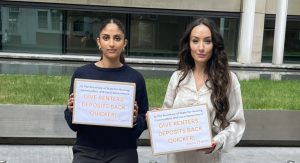
“We are returning to Ukraine because we have not found an apartment to rent”
As of March 2023, 222,000 visas have been awarded to Ukrainians fleeing from the war. This Saturday marks the first anniversary since individuals were able to act as sponsors in the Homes for Ukraine scheme, which accounts for 70% of all visas.
Over recent months, Generation Rent worked with the Ukrainian organisation Opora to investigate the experiences of Ukrainian refugees in navigating the UK’s housing sector.
Ukrainians overwhelmingly reported a host of obstacles preventing them from accessing good quality homes. And, those Ukrainian refugees who were able to find accommodation to rent faced various standards and repair issues.
Too many respondents were being presented with three options: become homeless, endure poor quality housing, or return to Ukraine. Clearly, things need to change.
We would like to thank the 325 Ukrainian refugees completed the survey, which ran between 21 November 2022 and 8 January 2023.
The research found that Ukrainian refugees are looking to the private rented sector for a home. 80% of all respondents were currently a private renter, had been a private renter previously, or were actively looking to become a private renter. However, a range of obstacles lie in the way of Ukrainian refugees accessing housing.
Key results
• 67% of those who had looked for somewhere to rent had struggled to find a landlord or letting agent to rent to them as a migrant or refugee.
One respondent said: “I need to find a place to rent within 2 months. The deadline has already been reduced to 1 month, and the search has been unsuccessful. Many agencies, when they hear an accent, when they see a foreign surname – they simply say that everything is busy for viewing weeks ahead.”
• 54%, over half, had struggled to find somewhere affordable to rent.
One respondent said: “During my six-month stay in Britain, I found a permanent job, my son likes to attend a local school. However, there is almost no housing for rent in our area. And the average cost of a house is 1,500 pounds per month, which is extremely expensive for a single mother from Ukraine.”
• 49%, nearly half, had struggled to find money for a deposit to rent a home.
One respondent wrote: “There were agencies that categorically refused to cooperate while I was receiving Universal Credit. They ask for payment of at least 3 months plus a deposit.”
• 43% had struggled to provide a work history to secure a rented home.
One respondent explained: “The problem is finding an apartment for rent without an active work contract. I currently live in a rural area where there is absolutely no work. I take my child to school in the neighbouring village. There is no time to travel to another place because the child has to be picked up from school. I am looking for an apartment to rent in a small town so that I can work. But no one wants to rent me an apartment because I am unemployed.”
In addition, those Ukrainian refugees who do rent face similar issues to other renters regarding, for example repair and maintenance, and find it very difficult to resolve issues that arise.
• 63%, almost two thirds of those who had found a home in the private rented sector indicated that they had experienced at least one maintenance issue.
One respondent wrote: “It was very difficult to find housing. We cannot compete with Scottish tenants who have work history, good credit etc. We will lose in advance. We were lucky only because an acquaintance of the family of our sponsors was going to rent out housing and came to meet us… we had to turn a blind eye to a number of problems in the property.”
• 46%, almost half of Ukrainians living in the private rented sector reported that they had experienced mould or damp.
One respondent stated: “There was mould in the bathroom, a window in one of the bedrooms was leaking, the washing machine was breaking down, the water heater in the bathroom was breaking down, there is still no hot water in several places.”
Too many respondents were being presented with three options: become homeless, endure poor quality housing, or return to Ukraine. Clearly, things need to change.
In order to prevent a homelessness crisis amongst Ukrainian refugees, the government must:
- Increase flexibility in funding for hosts
- Increase flexibility across the different visa schemes
- Harmonise funding across schemes
- Appoint a Minister of State for Refugees
- Enact another nationwide call for host families
- Issue guidance to local authorities on how they should be supporting Ukrainian refugees
- Maintain the £10,500 tariff given to local authorities
- Work with landlords and letting agents to ensure that Ukrainian refugees are able to access accommodation in the private rented sector
- End demands for upfront rent