Over the past decade, the rapid growth of second homes and AirBnb-style short term lets has increasingly driven families out of their communities as their homes get repurposed as holiday homes for tourists. This trend is particularly pronounced in popular coastal destinations in the South West of England and Norfolk, as well as in London, where housing pressures are already acute.
By 2022, there were over 330,000 holiday homes in England, equivalent to around 7% of the private rented sector. This comprised 256,913 second homes, registered for council tax, and 74,461 commercial holiday lets, registered for business rates. Many holiday lets tend to be registered for business rates because they qualify for small business rate relief (SBRR) and so pay less in local tax than they would if registered for council tax.
Many second homes are let out as holiday lets, as HMRC data from 2023/24 indicates, with 130,000 taxpayers declaring holiday let income in their tax returns. This is often the case in cities, where higher business rates reduce the benefit of the SBRR, so it works out cheaper for owners to pay council tax.
This expansion in the holiday home sector has been accelerated by a lack of effective regulation of short-term commercial holiday lets, alongside tax advantages that make holiday lets more profitable for landlords than residential tenancies. Together, these factors have incentivised landlords to favour tourists over residential tenants, further reducing affordable housing supply for local residents and pushing up rents.
Recent policy changes
In response to these pressures, a number of policy changes have been introduced in recent years. In April 2023, the then Conservative Government introduced new eligibility rules for business rates on holiday homes (which include both second homes and holiday lets) in England. For holiday lets to qualify for non-domestic business rates, the property must be available to let for short periods commercially for at least 140 nights in the year and actually be let for a minimum of 70 nights in the same period.
Further reforms followed in April 2025, when local authorities were granted discretionary powers to charge up to 200% of the standard council tax rate on second homes. So far around 70% of local authorities in England have chosen to exercise this new power. As a result, many holiday lets that paid no local taxes in 2022 first became ineligible for business rates, having to pay council tax, and subsequently were charged twice the level a resident would be, making them less profitable in comparison with residential tenancies.
Another set of changes was announced in 2024, with holiday let operators no longer able to deduct mortgage interest costs from their taxable income. This represented another advantage holiday lets had over residential tenancies in recent years, and the change means the two uses are now on a level playing field. The change took effect in 2025-26. Finally, we’re expecting the current government to announce a new register of tourist accommodation that will make it easier for holidaymakers to check if a let is legal, and for councils and policymakers to monitor the size of the sector and make decisions about housing supply.
What effects have these changes had?
By analysing data from September 2025, we are able to provide an early indication of how these regulatory and tax changes may be influencing the number of holiday homes across England. The holiday lets data we used came from the Valuation Office Agency via a Freedom of Information request, and the Second Homes data was drawn from MHCLG council tax data.
Trends over recent years
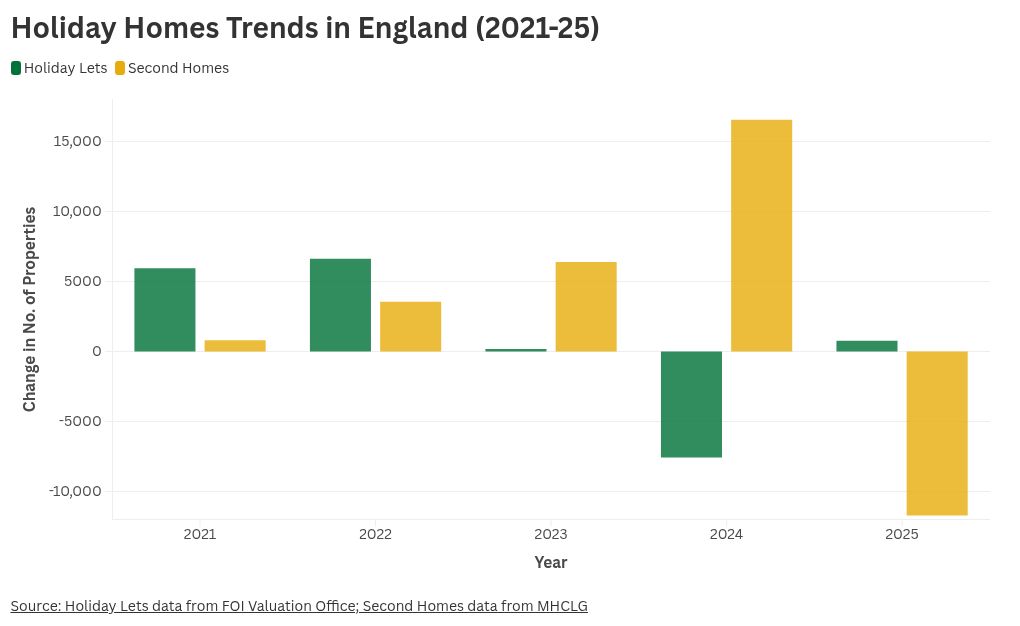
As the new tax and regulatory changes have been introduced, we can see that, first, the number of holiday lets stopped growing in 2023, then dropped significantly in 2024. Second home numbers kept growing in 2023 and 2024, likely a result in part of new eligibility rules prompting owners to switch to council tax. Their number has since fallen by over 11,000 in 2025, with only a small net increase seen in holiday lets, presumably as a result of the higher council tax charged. We will need to keep observing trends over the next couple of years to see if this downwards trend continues.
However, there are also large changes at a local level which complicate the picture. In 2025, there were 268,152 second homes, and 67,858 holiday lets – a total of 336,011. This is up from 2022 but down on 2024’s peak of 346,956.
Which areas have the biggest holiday home sectors?

Currently, the top 10 local authority holiday home hotspots, based on holiday homes as a proportion of total housing stock, are as follows:
- Isles of Scilly (31%)
- City of London (24%)
- North Norfolk (14%)
- South Hams (12%)
- Kensington and Chelsea (9%)
- Cornwall (9%)
- Westminster (8%)
- North Devon (7%)
- Great Yarmouth (7%)
- Torridge (7%)
These are the areas that have seen the largest fall in holiday homes since 2022.
| Local Authority | Decrease in number of holiday homes as % of total homes 2022-2025 | |
| 1 | Camden | -2.87 |
| 2 | Cambridge | -1.60 |
| 3 | Leicester | -1.60 |
| 4 | Chichester | -1.49 |
| 5 | Enfield | -0.83 |
| 6 | Portsmouth | -0.71 |
| 7 | Great Yarmouth | -0.70 |
| 8 | Torridge | -0.65 |
| 9 | East Devon | -0.63 |
| 10 | Teignbridge | -0.60 |
These are the areas where holiday homes have continued to increase as a share of the local housing stock.
| Local Authority | Increase in number of holiday homes as % of total homes 2022-2025 | |
| 1 | Westminster | +5.84 |
| 2 | City of London | +1.63 |
| 3 | Wandsworth | +1.41 |
| 4 | Oxford | +1.16 |
| 5 | Lambeth | +0.95 |
| 6 | Ealing | +0.95 |
| 7 | Lincoln | +0.93 |
| 8 | Tower Hamlets | +0.86 |
| 9 | Somerset | +0.81 |
| 10 | Runnymede | +0.64 |
Second Home Premiums: how widely are councils using them?
At present, 211 out of 296 (71%) English councils are charging Second Home council tax premiums, with 170,307 properties subject to it this year. While uptake has been widespread, a number of notable exceptions remain. For example, Kensington and Chelsea are currently not charging second homes premium, despite having 7898 second homes. These properties account for 100% of their recorded holiday homes and make up 9% of their total housing stock. However, the council has recently indicated that it is reconsidering its discretionary powers to charge additional council tax premiums to second home dwellings.
Outliers
The number of holiday homes in Manchester appeared to fluctuate significantly over the last 18 months. Manchester’s housing stock has been changing rapidly, with many new large blocks of flats being built. The council told us that these flats often start with a ‘second home’ council tax classification due to them being furnished properties but with unknown occupancies, as opposed to ‘true’ second homes. In comparison, homes classed as empty typically come unfurnished.
Over time, these properties may be reclassified as student accommodation exemptions or occupied dwellings, a process which can take several months. This lag may help to explain the temporary spikes in second home numbers observed in the data. We found that 73% of second homes in Manchester are currently not paying the relevant premium, also likely due to this delay in the second home reclassification process. Similarly, we found that the number of second homes in Wandsworth has increased by nearly 2000 in the past couple of years, which the council attributed to new buildings in Nine Elms being bought as second homes.
In Westminster, our analysis found that, out of the 11,000 second homes currently in the local authority, 8,000 of these were newly registered on the council tax register between September 2024 and September 2025. This sharp increase appears to reflect proactive enforcement by the council. Under the new regulations, local authorities were required to wait 12 months before levying second home premiums, meaning charges only began in April 2025. Since then, Westminster council has been very pro-active in identifying previously undeclared second homes, explaining the large increase observed.
Camden has experienced the most significant decrease in proportion of holiday homes between 2021 and 2025, with a fall of three percentage points. At the same time, this council has seen a 61% increase in the number of Empty Homes Premium charges over that time period. The council explained that beyond the single annual screenshot that the council tax data provides, there is significant churn of furnished properties that move in and out of the ‘second homes’ classification throughout the year. Changes in council tax rules and new premiums prompted residents to update how their properties are classified, for instance by claiming their second homes as their primary residence, or as empty and unfurnished, leading to sharp short-term changes in the recorded numbers.
Given that local authorities have only been able to exercise these powers for the past nine months, it is still too early to draw firm conclusions about the long-term impact of these new measures on the number of holiday homes – and the supply of homes for locals as a result.
In addition, these large swings in the number of second homes at a local level, partly caused by administrative changes, make tracking the real trends in holiday homes more difficult. Westminster, Wandsworth, Bristol, Ealing and Lambeth, which each recorded more than 1000 additional second homes between 2024 and 2025, represent nearly 13,000 additional second homes between them. If just some of these are newly identified second homes, rather than actual new ones, the true fall in second home numbers is even larger than the figure we set out above.
We will continue to monitor this data closely to determine whether these policy changes are genuinely returning homes for long-term residential purposes.
In the meantime, we are calling on the government to give councils powers to license holiday lets and limit their number, in order to strike a balance between the two uses that suits the local population. Read more.
How do empty homes fit into this?
Nationally, the use of Empty Homes Premium, which has been in place for much longer, has risen sharply. This premium is applied to homes that have been left empty for at least one year to incentivise property owners to bring vacant properties back into use. Between 2023/24 and 2024/25, the number of dwellings in England charged with this premium increased from 75,803 to 119,606. This surge is likely linked to the change in legislation that reduced the qualifying empty home period from two years to one, enabling councils to charge more quickly in long-term empty homes.