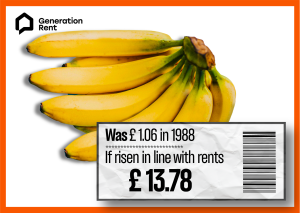
One in five of Britain’s private renters lives in London, and the capital is one of the least affordable places to rent your home. Things have got so bad, the average renter is handing over £100,000 to their landlord every four years!
London’s housing crisis means that people who are there to work in their dream job, or be near their community, are putting up with cramped homes and long commutes to get by. It also means that key workers like teaching and medical staff are moving away to areas where it is still possible to buy a house, putting public services under greater strain.
If we can fix London’s housing crisis, we’d be a long way towards fixing the housing crisis affecting the rest of the country too. The government’s main policy so far is to set a target of 88,000 homes to be built in London every year (as part of the 300,000 national target). Based on our research last year, we think that could make a big difference to the affordability of rents. But a lot of things need to go right to achieve that – it involves more than doubling the rate of housebuilding London currently does.
The Mayor of London recently invited comments on the next London Plan, which will guide councils and builders towards building the homes London needs. We submitted our ideas – here is a quick summary.
Brownfield first
When figuring out where all the new homes will go, it makes most sense to prioritise areas that are closest to jobs and existing communities where people want to live. Brownfield is land that has already been built on but isn’t being used. However, there’s not all that much of it so the homes that are built there should be dense – i.e. mostly flats – to make the most of it.
A lot of London, particularly inner boroughs, is not very dense at all – just terraced and semi-detached houses in areas where rents are very high, indicating that a lot of people want to live there. Redeveloping streets of houses as flats would accommodate more people in these popular areas, meaning fewer people would have to move further away from their work, family and friends to find something affordable. The people living there currently would need to have a say in any changes to the area – the last government created a law called Street Votes which makes this possible. Though renters need a say too – and to be compensated for the disruption (theoretically easy to pay for as all property owners would get a windfall from the redevelopment).
Green belt next
Unfortunately, even if we built lots of flats on London’s brownfield land and densified some of the city we would still fall short of the building targets. It has been very difficult for London to expand outwards because of the green belt. This has led to people moving out of London to towns on the other side of the green belt, and commuting into London – often driving, with all the carbon and air pollution that creates, not to mention the costs of more time away from family.
Better to have people living closer to their workplace – and the green belt contains numerous Tube and rail stations surrounded by fields that could support new communities. The government is proposing redesignating a lot of this land as “grey belt”, making it easier to build on, which we support. Most green belt is intensive farmland with very little environmental value; losing those bits close to the public transport network would make no noticeable difference to overall food supply.
The Mayor of London has also proposed to review the green belt more generally and remove golf courses from Metropolitan Open Land. Golf’s popularity is waning to the point where many of London’s 90 courses are struggling – and these sites don’t offer the same access to the general public as parks do. It would be much better to repurpose this land as homes, retaining plenty of green space for local people and nature.
Affordable housing
As London has prospered, and more Londoners are working in well-paid jobs, the competition for homes has increased, with higher spending power pushing up rents, so people on more modest incomes increasingly struggle to find a home they can afford. Many of these people grew up in London, and it is unreasonable to force them to move away from their family and friends. That’s why we need social housing – but London has not been building enough of it.
As a result, families are being made homeless because they have been evicted and are unable to find an affordable private tenancy – 90,000 children are living with their families in temporary accommodation.
We need to build more social homes, but we should also take care about what terms these homes are let at. Social homes that have been built in the past decade or so are typically at “affordable” or “intermediate” rent worth up to 80% of market rents, rather than “social rent” which is based on incomes. Because market rents can rise faster than wages, these rents should not be considered affordable. Average tenants in affordable housing are paying around 50% of their income on rent, compared with 40% for people in social rent housing.
Right now households relying on Universal Credit or Housing Benefit to pay their rent are, in most parts of London, able to cover the rent with Local Housing Allowance rates, but these have been frozen and the longer they are frozen, the more affordable rent tenants will start having to dip into other benefits to keep on top of the rent.
While the government has set out a 10-year funding package for social housing investment, it remains to be seen how many homes this will build in London. Social housing can also be built by private developers as part of Section 106 deals struck when planning for-profit developments. How much social housing councils and the Mayor of London should demand from private developers is an ongoing debate. Ask for too little and more families end up in temporary accommodation; ask for a lot and developers stop building. There is a sweet spot somewhere but London hasn’t found it yet.
HMOs
The demand for homes from young single adults has led to landlords buying three- and four-bed family homes and turning them into four-, five- and six- bed HMOs (Houses in Multiple Occupation), increasingly with minimal communal space. This trend has made it harder for families to find homes in London, to the extent that some schools are no longer viable because so many families have been priced out of the neighbourhood. A lack of single-occupancy housing for HMO residents means many spend longer in this type of accommodation than they would like.
Easing demand for HMOs will be important to free up houses for families – but there shouldn’t be planning controls stopping landlords renting to certain types of household, which makes it harder for young adults to find accommodation in London. It is important to build housing that meets the demand from single adults.
Purpose-built student accommodation and co-living provides alternatives to students and non-students respectively, though it won’t suit everyone currently in the HMO sector, because of the high cost and the need to share facilities including kitchen. It should be seen as an alternative for people who may otherwise enter the HMO sector, but not for people who do not want to live in an HMO in the first place.
The Centre for Cities argues that space standards are stopping the provision of more mainstream 1-bed homes. 50sqm and 37sqm flats are the minimum standard for couples and single households respectively, but the cost of renting homes at these sizes mean it is much cheaper for renters to rent a room in an HMO, and so few 1-bed flats actually get built. The average space per person in the private rented sector is 25sqm, indicating most of us renting in London are already used to limited space.
To help people out of HMOs and into their own home, space standards could be loosened without drastically impacting quality of life for renters. E.g. many renters would happily trade a shared home for a 25sqm studio, and many couples could comfortably move into a 40sqm one-bed flat. Any changes would have to be in line with the Decent Homes Standard, to avoid developers cutting corners at the expense of renters’ health and wellbeing.
Build to Rent
As long as home ownership is out of reach for a majority of London’s renters, much private sector investment in new homes will come from landlords. It is important that these investors have the right motivations and are committed to providing long term homes to their tenants.
Build to Rent (BTR) was originally pitched as a professional alternative to buy to let, with patient, institutional capital (e.g. from pension funds) placing value in long term tenants, and so providing greater certainty in terms of tenure and rental costs than amateur individuals, whose personal needs can so easily result in shock rent hikes and unwanted moves.
However, we have heard concerning stories of Build to Rent operators seeking to maximise rents and pulling the rug from under their tenants’ feet. The i paper reported in 2024 on a BTR project in Southwark, which was serving section 21 eviction notices and demanding above-inflation rent increases. This was a private equity-backed developer, rather than a pension fund, and it was not clear if it was breaking commitments to the local authority, but we are concerned if this type of investor is behind a lot of BTR development in London.
Under the current London plan, BTR projects are encouraged to offer longer tenancies and index-linked rents. It is important that the GLA has a clear sense of how common it is for these projects to make such commitments, how closely developers/operators stick to them, and whether oversight of Build to Rent should be strengthened.
Another issue is around how affordable BTR really is for private tenants, and how much it contributes to accommodating the people who need housing the most. Because the homes are newer, they typically fetch a higher rent. This can reduce pressure on the local area, so wealthier tenants move into the new flats rather than the older homes nearby, which is what otherwise happens, and encourages landlords to raise the rent on existing tenants (or evict them while Section 21 still exists). But without providing a contribution to social housing, BTR won’t directly reduce waiting lists or take families out of temporary accommodation.
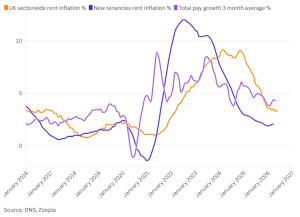
Of course, all efforts to increase the number of homes will take a long time to translate into more affordable rents and better living standards for Londoners. The Mayor needs a range of tools to tackle housing affordability but what he currently does not have are powers to slam the brakes on soaring rents. The government should hand decisions over rents to city region Mayors and let them devise policies that will get housing costs under control.