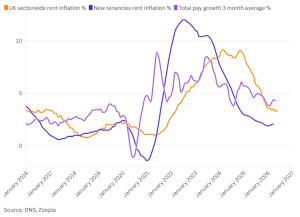
In three years to 2024, over a third of London councils did not prosecute a single criminal landlord. At the same time, the cost of renting in the capital has soared, with Londoners typically spending 42% of their income on rent.
Generation Rent’s Chief Executive, Ben Twomey, gave evidence on implementing and monitoring the Renters’ Right Act in London at the London Assembly Housing Committee on 20th January 2026. He warned that these much-anticipated reforms will only be as effective in London as the enforcement behind them, calling for local governments to strengthen council capacities to hold landlords accountable. He also highlighted the urgent need for rent controls in London. You can read Ben’s full written submission for the London Assembly’s Housing Committee’s Call for Evidence here.
The Renters Rights Act in London
The Renters’ Rights Act has the potential to transform renting in London. If it works as intended, it could finally give millions of private renters’ stability in their homes. For too long, renting has meant insecurity, poor housing conditions and constant anxiety about the next move. The new law promises a different future, one where we can settle in communities, plan our lives, and hold our landlords to account.
You can read a comprehensive summary of the changes to come here.
Will the Act be successful in London?
Despite these momentous changes, law is only as strong as its enforcement. London councils will play a crucial role in making these reforms real, yet many already struggle to enforce existing housing rules due to limited resources. The UK Government in November 2025 announced £18 million in “new burdens funding” to help councils prepare for the Act, but local authorities have already stated that this does not go far enough. Evidence from across London shows enforcement remains patchy at best, with thousands of tenant complaints resulting in very few formal enforcement notices or penalties for landlords. Early robust enforcement is a crucial deterrent against unlawful landlord behaviour.
14 out of 32 London boroughs are not listed on the GLA’s Rogue Landlord Checker, a database where renters can look up landlords to see if they have fines, prosecutions, revoked licences or even banning orders in their area over the last three years. However, because it is not mandatory for local councils to update the Checker and there are disparities in enforcement, it is not currently a reliable tool for renters to use.
Empowering renters themselves will be just as important. Many London tenants still lack confidence in challenging landlords, particularly when they fear retaliation or doubt councils will act. Strengthening awareness of renters rights, as well as making it easier for renters to pursue compensation through mechanisms like Rent Repayment Orders, could help build confidence in renters to not tolerate any more bad behaviour from their landlords or letting agents.
Concrete indications of the Act’s success would be:
- Fewer people becoming homeless from the end of private tenancies
- More tenants staying in their home for 3 years or more, as recorded in the English Housing Survey
- Fewer unwanted moves reflected in MoJ court claims or tenancy deposit scheme data
- More renters confidently exercising their rights, shown by higher numbers of rent challenges and RRO cases succeeding.
- Increased enforcement activity from councils as housing standards improve
- High levels of landlord and property registration with the new database and ombudsman once established
How to strengthen the Act in London?
The Mayor and the GLA should expand the Property Licence Checker so renters can more easily identify offences that may qualify for Rent Repayment Orders. As councils will take different approaches to enforcement, City Hall could also play a coordinating role or act as a backstop where local support for renters is lacking.
The Mayor should also consider creating a legal fighting fund to support councils in taking action against rogue landlords. Many local authorities are understandably cautious about pursuing complex or costly cases, particularly when landlords operate across borough boundaries. Early investment could help build a strong, self-sustaining enforcement system, and make sure the worst offenders are held accountable.
Finally, the Mayor and GLA should closely monitor enforcement across London, supporting the sharing of best practice and ensuring councils are transparent about their activity. The real test of legislation will be whether it improves renters’ lives, and where it falls short, both in terms of weak enforcement or low levels of awareness.
How to spread awareness of the Act in London?
London has a major opportunity to raise awareness of renters’ new rights. With such a large renter population, and clear data on where they live, local advertising and using the Transport for London network would help reach millions of private renters directly. Councils can also share information through public spaces such as libraries and local newsletters.
Too often, renters rely on information from landlords or letting agents leaving them vulnerable to misinformation. Clear and impartial information tools will be essential as the Act comes into force, particularly to avoid confusion around issues like fixed-term tenancies and the timing of the Section 21 ban. Generation Rent is already working to spread awareness through events, webinars and resources as part of this years’ Renters’ Rights Awareness Week taking place from 27 April to 3 May 2026. Please find our rights information pages here.
The London Assembly Housing Committee was able to reflect much of our evidence after it was given, in a letter to the Mayor of London making recommendations particularly on raising awareness of the Act among renters, which you can read here.
Affordability of renting in London
Despite the wonderful changes to come, the Renters’ Rights Act still leaves a major issue untouched, which is the soaring cost of rent. For most renters, affordability remains the biggest challenge of all. That is why many campaigners believe the next step must be stronger action on rent regulation; something that is widely used across Western Europe to limit excessive increases and stabilise housing costs.
The Mayor of London has long called for powers to be devolved so that he can take action to limit rent rises in the capital. We think it is long overdue that he starts making representations to government on behalf of London’s renters.
The Renters’ Rights Act represents the biggest reforms to renting in a generation. It could mean fewer families pushed into homelessness or temporary accommodation, as well as more flexible tenancies and safer homes across London. Its success will depend on three things: renters knowing their rights, councils having the resources to enforce the law, and politicians having the courage to go further where the reforms fall short. That is how we will we see a true transformation to private renting.