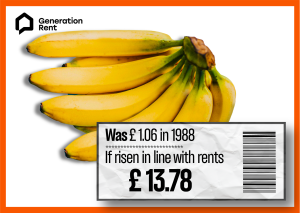
Generation Rent has today unveiled the ‘Cost of Renting Receipt’*, laying bare the huge increase in the cost of private rents since the 1988 Housing Act.
The campaign group’s analysis** found that, if the price of everyday groceries had risen at the same rate as private rents since 1988, a standard ten item shop from a supermarket would cost more than five times what it does now.
The 1965 Rent Act introduced regulated tenancies with long-term security of tenure and fair rents assessed by independent rent officers. However, the 1988 Housing Act abolished this system, meaning 1988 was the last time there was a clear system of regulation to limit the cost of private rents.
At £1442, the average monthly rent in England is thirteen times higher now than it was in 1988 (£111). If the cost of a standard ten item grocery shop** had risen at the same rate, it would cost (on average) £117.13, compared to £22.67 now and £9.01 in 1988.
The impact of this is laid bare through comparisons to the cost of everyday groceries. A pack of 12 eggs, for example, would cost £12.31 if the cost had risen at the same rate as private rents since 1988, compared to £3.31 now. Or a 500g pack of cheddar cheese would cost £19.50 compared to £4.31, while a whole chicken would cost £23.79.
On average private renters in England spend over 36% of their income on rent, with this figure rising to well above 40% in many major cities. Generation Rent is calling on Andy Burnham’s government to urgently introduce a limit on how much landlords can hike the rent, capped to the lower of Consumer Price Inflation or wage growth. Similar policies have recently been endorsed by influential think tanks such as IPPR, the Joseph Rowntree Foundation, the New Economics Foundation and the Fabian Society.
Holly Williamson, Chief Executive of Generation Rent, said:
“Homes are the foundations of our lives. We wouldn’t accept paying such extortionate prices for our food shop, so why do we accept it when it comes to our homes? High rents are backbreaking for renters across the country. It can mean children going to school hungry, families trapped living in temporary accommodation for years, or older renters choosing between heating or eating.
“The cost of renting is like a runaway train with no driver, leaving too many renters as passengers with no control over our lives. With another spike in inflation looming, Andy Burnham’s government can and must act urgently, by bringing in a limit on how much landlords can hike our rents.”
Darren Baxter, Principal Policy Adviser at the Joseph Rowntree Foundation, said:
“Unaffordable private rents aren’t a given. They’re a symptom of a housing system that has let private profit come before decent, affordable homes, with successive governments failing to tackle the problem. Trapped in a cycle of high rents, financial strain and no ability to save – renters are often just one redundancy or illness away from a crisis.
“We need this government to ease the pressure on private renters by introducing rent controls. This would put money back into renters’ pockets so they can start to rebuild their financial safety net and weather life’s challenges.”
Notes to editors
**Analysis compared the average monthly rent in 1988, with the current average monthly rent in England, finding the current average monthly rent is thirteen times higher than 1988. It then took average prices of everyday groceries in 1988 (according to Which) and multiplied them by thirteen. Current average prices of groceries were taken from the ONS Consumer Price Inflation series.
***Full data set
| Grocery item | 1988 (£) | Now (£) | If risen with rents (£) |
| Bananas (1kg) | 1.06 | 1.02 | 13.78 |
| Butter (250g) | 0.54 | 2.43 | 7.02 |
| Eggs x12 | 0.95 | 3.31 | 12.35 |
| Loaf white bread | 0.52 | 1.4 | 6.76 |
| Whole Chicken | 1.83 | 3.78 | 23.79 |
| Milk (pint) | 0.26 | 0.65 | 3.38 |
| Instant coffee (100g) | 1.31 | 3.85 | 17.03 |
| Carrots (1kg) | 0.5 | 0.79 | 6.5 |
| Cheddar (500g) | 1.5 | 4.31 | 19.5 |
| Sugar (1kg) | 0.54 | 1.13 | 7.02 |
| Total | 9.01 | 22.67 | 117.13 |
Even comparing today’s rents to uncontrolled rents shows how out of step with other essentials housing has become in the past few decades. After rent controls were abolished, the average market rent in 1990 stood 82% higher than the average private rent was in 1988, at £202 per month. Since then rents have risen sevenfold, nearly three times faster than food prices.