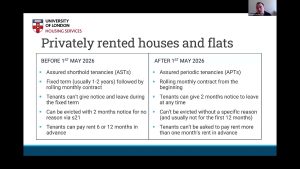
The changes to tenancies and evictions under the Renters’ Rights Act (RRA) that come in on 1 May 2026 affect students differently from other types of renters – exactly how depends on the type of accommodation you live in.
Some student housing is fully exempt, some is partially exempt (with the landlord able to evict tenants at the end of the academic year), and some students will experience all the new protections (there will still be other eviction grounds that the landlord may be able to use in some circumstances).
The rules depend on who owns or manages your accommodation and who you live with.
Learn about the wider changes under the Renters’ Rights Act here.
CATEGORIES OF STUDENT TENANCY
1. Student Accommodation exempt from the RRA
These types of accommodation do not need to follow the new rules.
University-owned Halls of Residence
- Typically offered to first year students only.
- You are likely on a licence agreement or common law tenancy, not a standard tenancy agreement
- This means that Halls of Residence can:
- offer fixed-term contracts (typically in line with the academic year), and
- require you to leave at the end date cited on your contract at the end of the academic year
Universities can let accommodation to non-students on periodic tenancies but can evict using Ground 4 if the accommodation is needed to let to students.
Purpose-Built Student Accommodation (PBSA) registered with the National Code.
- You can check if your accommodation is signed up to the National Code here.
- They can:
- offer fixed-term contracts (tends to be in line with the academic year), and
- require you to leave at the end date cited on your contract at the end of the academic year
- Tenancies that started before 1 May 2026 become periodic tenancies. Tenants can be asked to leave under Ground 4a (explained below). Where tenants pay rent in instalments of more than a month (e.g. 3 or 4 times a year), it is unclear if they can give two months’ notice, as would be the case if they paid monthly. Such students are advised to seek advice if they wish to end the tenancy before the date originally agreed.
2. Student Accommodation covered by the RRA
PBSA not registered under the National Code
- These providers are fully covered by the RRA
- Your tenancy will be rolling (periodic), and you can leave at any time with 2 months’ notice.
- Landlords need a valid ground for eviction
3. Renting from a Private Landlord or Letting Agent
Most students renting houses or flats from private landlords and letting agents are covered by the RRA, but different rules apply depending on the number of people you are living with, and student status of your housemates.
A. Houses in Multiple Occupation (HMO): Three or more full-time students living together
You will have most RRA protections including a rolling tenancy, and the ability to move out whenever you choose with 2 months’ notice. However, landlords may use a special student eviction ground called Ground 4a.
What is Ground 4a?
- This ground allows landlords evict students at the end of the academic year.
- This only applies if:
- The letting is an HMO i.e. there are three or more unrelated people living in the property
- All tenants were full-time students at the time the tenancy was signed
- The landlord intends to re-let the property to a new group of students
For Ground 4a to be valid, your landlord must:
- Make you aware, in writing, of their intention to use Ground 4a before you sign your contract
- Specify a move-out date between 1st June and 30th September, with 4 months’ notice period
- Agreements for the next academic year cannot be signed more than 6 months in advance of the tenancy start date (the “6-month rule”).
If your tenancy started before 1 May 2026, your landlord must give written notice of Ground 4a on or before 31 May 2026, and the 6-month rule will not apply.
A note on HMOs: If your landlord is supposed to have an HMO licence but doesn’t, you may be able to claim a repayment of rent. Shelter has more info.
B. Non-HMO lettings: Students living alone, or with one other student
You are in a non-HMO letting if you:
- Live alone in a studio or one bedroom flat, or
- Live with just one other student or non-student
This means that you are fully covered by the RRA, and a Ground 4a cannot be used on your tenancy.
C. HMOs containing non-students
If you are a student living in a shared house with non-students (and there were non-students on the tenancy when it was signed):
- You receive full RRA protections, and
- A Ground 4a cannot be used on your tenancy
It may be important to note that due to this new Ground 4a condition, landlords may be less likely to accept household tenancies that contain a mix of both students and non-students, potentially making it harder to find accommodation.
Summary: When do I need to move out of my student accommodation?
| Student Accommodation Type | When do I need to move out? |
| University owned Halls of Residence | At the end date stated in your fixed term contract (usually end of the academic year. |
| Purpose-Built Student Accommodation (PBSA) registered with the National Code | Tenancies starting before 1 May 2026: After giving 2 months’ notice or after a Ground 4a notice. Tenancies starting after 1 May 2026: At the end date in your fixed term contract. |
| PBSA not registered with the National Code | Whenever you choose, with 2 months’ notice. |
| Private shared housing (HMO) accommodating 3 or more full-time students | You can leave with 2 months’ notice at any point, but your landlord is likely to issue a Ground 4a notice which will require you to leave at the end of the academic year. |
| Private student housing (non-HMO, living alone or with one other person) | Whenever you choose, with 2 months’ notice. Landlord can still use other eviction grounds if appropriate. |
| HMO accommodating non-students as well as students | Whenever you choose, with 2 months’ notice. Landlord can still use other eviction grounds if appropriate. |