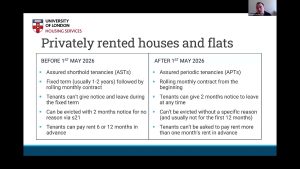
Since 1st May 2026, your landlord or letting agent cannot ask you to leave without a formal “notice seeking possession” from your landlord (Form 3A) and they must have a valid reason to end your tenancy.
Section 21 evictions have now been scrapped in England, and a landlord cannot use these against you as their tenant anymore. These evictions were sometimes called “no fault” evictions – although they have been scrapped it is still possible to face eviction through no fault of your own, e.g. if the landlord wants to move themselves or a family member in, or sell the property.
If your landlord served you with a Section 21 up until midnight on 30th April 2026, and you haven’t left the property, your landlord will still be able to apply to the court for a possession from the date the notice expires until 31st July 2026. If they do not do so then they would need to serve a new Section 8 notice seeking possession with a valid ground for eviction.
Landlords cannot evict you simply because they want new tenants or you’ve asked for maintenance. Your tenancy will continue until you choose to leave or your landlord uses a Section 8 eviction and goes through the correct legal process.
Your landlord must use a Section 8 notice, setting out one or more of the legally approved reasons (known as “grounds for possession”). These include situations such as:
- The landlord wants to sell the property or move in themselves or a close family member
- You have rent arrears
- You have engaged in antisocial behaviour.
Landlords who try to avoid serving a Section 8 notice, for example by claiming to end the tenancy verbally, or using a “notice to quit” or a purported notice of possession, could be fined up to £7000 by the local council.
The landlord must follow strict rules about notice periods and evidence. To use a Section 8 eviction, a landlord must have done every one of the following:
- Provide a written Section 8 notice that clearly states the legal ground for possession.
- Give the correct notice period, which depends on the reason for evicting you, also known as the ‘ground’.
- If the landlord is evicting you to move themselves or their family member is (Ground 1) or to sell the home (Ground 1a) they must give you at least four months’ notice. They cannot ask you to leave on these grounds before the first 12 months of the tenancy have passed. To prevent misuse of these grounds they will be banned from re-letting the home for 12 months. If you see the home has been advertised for let, or occupied by tenants in this period, you may be able to claim a refund of rent.
- If the landlord is evicting you because of significant rent arrears (three months’ worth; Ground 8), other rent arrears (Ground 10) or persistent arrears (Ground 11) they must give you at least 4 weeks’ notice.
- To evict a tenant for anti-social behaviour (Ground 14) a landlord can apply to the court immediately.
- A summary of the grounds can be found below. You can read a full list of the Grounds under Section 8 and their notice periods here.
- Protect your deposit in a government approved scheme (unless they are seeking eviction for anti-social behaviour).
If the notice is invalid, don’t tell the landlord (as they might simply reissue a valid notice), but be prepared to defend yourself in court. Consider contacting the government-funded Housing Loss Prevention Advice Service or other expert advice organisations for help.
Even if the notice is valid, your landlord must still get a court order and bailiffs to force you to move.
No one can force you out of your home except for bailiffs appointed by a court. Landlords doing this themselves, or otherwise pressuring you to move out outside of the formal legal process, may count as an illegal eviction or harassment, criminal offences under the Protection from Eviction Act.
Illegal behaviour also includes changing locks and cutting off utilities. If you are experiencing this you can contact your local council’s tenancy relations officer or the police for help. You may also be entitled to compensation or repayment of rent.
You can contact your local council if you need help finding a new home.
The following table is a summary of the eviction grounds, with detail about notice periods, conditions and if they are mandatory (the court must make a possession order if the landlord has the correct paperwork) or discretionary (the court can decide whether to make a possession order and you can argue against it). A full list is available here.
| Reason for eviction | Grounds | Notice Period | Conditions |
| Landlord wants to move themselves or a family member in, or sell the property | 1, 1A | 4 months | Mandatory. You are protected from this eviction ground for the first 12 months of your tenancy. |
| Mortgage lender or superior landlord wants to repossess the property, or the landlord is substantially redeveloping the property | 2, 2ZA, 2ZB, 2ZC, 2ZD, 6 | 4 months | Mandatory |
| If you’re living in student accommodation owned by a university or a college and they want you to move out | 4 | 2 weeks | Mandatory |
| You’re a full-time student living in a shared house with 2 or more students. Your landlord can use this ground if the property is needed for a new group of students in line with the new academic year | 4A | 4 months | Mandatory. Can only be used if landlord has given advance notice in the tenancy agreement of their intention to use this ground and the tenancy was agreed less than six months before the tenancy started. Read more |
| Employment linked to the tenancy has ended, social tenancy has ended, or tenant has died | 5, 5A, 5B, 5C, 5D, 5E, 5F, 7 | 2 months | Mandatory |
| If your landlord has been investigated for breaking the law | 6B | 4 months | Mandatory. The court is able to tell your landlord to pay you compensation |
| You have engaged in antisocial or criminal behaviour | 7A, 14 | No notice period, but the court can only make a possession order 2 weeks after the notice date | Mandatory if tenant has been convicted or has breached a relevant order; otherwise discretionary |
| You do not have the right to rent under immigration law | 7B | 2 weeks | Mandatory |
| You owe the landlord at least 3 months’ rent, or 13 weeks rent if you pay weekly) | 8 | 4 weeks | Mandatory. Ground does not apply if you owe less than the minimum amount of rent arrears by the time you get to court. If you are on rent arrears because you have not received Universal credit that you are owed, you will not be able to be evicted. |
| You have been offered alternative accommodation that is suitable for you | 9 | 2 months | Discretionary |
| Any or persistent rent arrears, or supported accommodation tenant refuses to engage with support | 10, 11, 18 | 4 weeks | Discretionary |
| Breach of tenancy, deterioration of property/furniture, domestic abuse, rioting, or false statement to obtain the tenancy | 12, 13, 14A, 14ZA, 15, 17 | 2 weeks | Discretionary |